
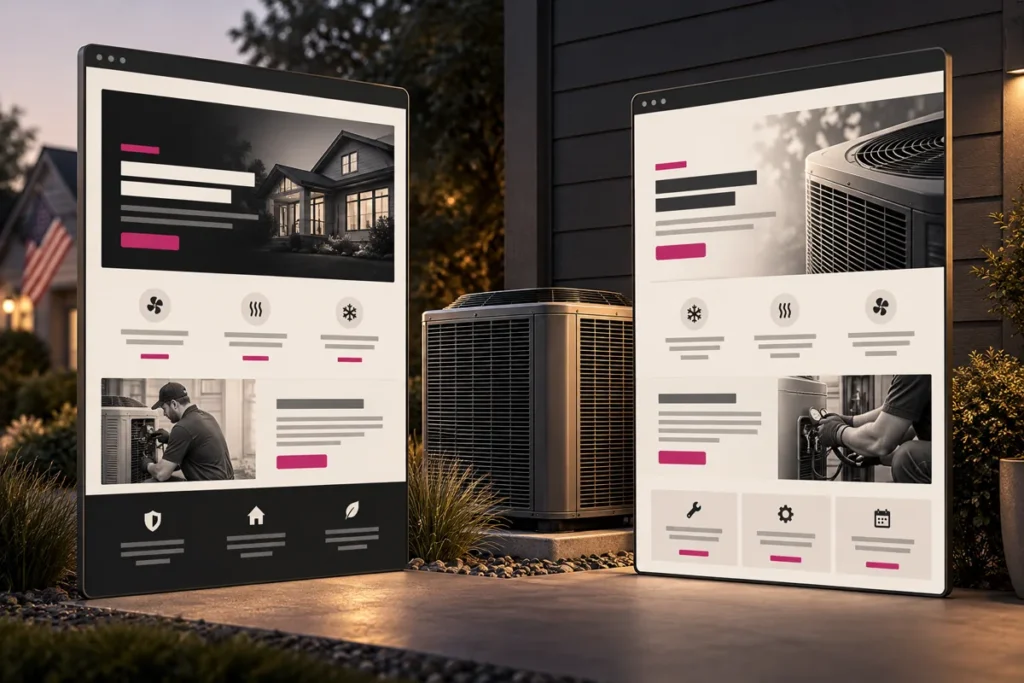
Original conceptual illustration; interface examples below are hypothetical, not client screenshots or measured results.
A focused HVAC landing page can suit a specific campaign, while a homepage helps visitors understand the broader business. Neither automatically converts better. The right destination depends on what brought the visitor there, what they need to know, and which action your team can fulfill.
A landing page is a destination, not a promise of performance
Technically, any page someone lands on can be a landing page. In campaign planning, the term usually means a page built around one offer, service, or audience. An HVAC homepage has a broader role: introduce the company, explain core services, show coverage and trust, and help different visitors find their route.
Google Ads describes landing-page experience in terms of relevance, useful information, navigation, and alignment with expectations after an ad click. It does not declare that a one-page layout always wins. See Google’s landing-page definition.
Homepage journey
Brand or broad search → choose a service → review fit → contact
Focused campaign journey
Specific service ad → matching explanation → relevant proof → contact
Illustrative paths. A shorter path can help, but it must still answer the customer’s important questions.
When a focused page makes sense
Imagine an ad about furnace replacement estimates. A matching page can explain the estimate process, supported service area, what information to prepare, and how the request is handled. Sending the same visitor to a homepage that leads with unrelated AC repair can force unnecessary searching.
Use one primary action that reflects the offer. Keep contact details, business identity, terms relevant to the offer, and useful navigation available. Reducing distraction should not mean hiding who runs the business or making it difficult to verify the service.
When the homepage is the better starting point
A visitor searching for your company name may want hours, phone numbers, service options, or evidence that they found the right company. A well-organized homepage can handle that broad intent better than an isolated promotional page. Referral visitors may also want to understand the business before choosing a service.
| Visitor context | Likely starting page | Reason |
|---|---|---|
| Brand-name search | Homepage | Broad company information and navigation |
| Specific repair search | Relevant service page | Matches the service question directly |
| Single-offer paid campaign | Focused landing page | Supports the promise made in the ad |
| General referral | Homepage or relevant service page | Depends on what the referrer recommended |
What should an HVAC campaign page contain?
Include the matching service or offer, real coverage, actual availability, an explanation of what happens next, and a usable contact action. Add credible proof relevant to the claim. Keep promotional conditions visible where applicable. Do not suggest a guaranteed appointment or financing approval if the form only requests a conversation.
For a repair campaign, a call action may fit staffed hours. For a planned replacement, an estimate form may be appropriate. Offer an alternative route without treating every visitor as urgent. Test on a phone, including labels, errors, and the bottom of the page.
Compare pages without misleading yourself
Do not compare cold paid traffic on one page with returning brand visitors on another and attribute the difference entirely to layout. Keep the audience, offer, device mix, and acquisition conditions comparable. Record which version a visitor sees and avoid changing several major variables at once.
Use successful accepted inquiries as a primary website measure, then review lead quality and booked jobs separately. Call-link clicks are an intermediate signal. A page generating more unsuitable contacts can burden the team without improving the business.
Document the hypothesis before testing: for example, “A service-specific explanation may reduce uncertainty for visitors from this replacement campaign.” The result may favor the homepage, the focused page, or neither with enough confidence. Avoid declaring a winner from a handful of inquiries.
Kllakar’s website design and development work can connect campaign messages to useful destinations and testable contact flows. For other bottlenecks, see why HVAC websites fail to generate enough leads.
Landing-page questions
Should a landing page remove every navigation link?
No universal rule applies. Simplify competing actions while preserving access to information visitors need to trust and understand the business.
Can an existing service page work for ads?
Yes, when it matches the campaign and offers a clear next step. Build another page only when the audience or offer needs a meaningfully different explanation.
Should campaign pages be indexed?
Decide based on their purpose and uniqueness. A useful evergreen service page may belong in search; a temporary or near-duplicate test variant may not. Review the implementation rather than applying one setting to every page.
Choosing a campaign destination? Share your HVAC offer and current landing page with Kllakar.